
Commission large displays with less trial and error
Define the overlap from the camera view, run a controlled correction and inspect the resulting spatial profile instead of repeatedly balancing several unrelated settings.
PROJECTION IMAGING | AUTOMATIC EDGE BLENDING
Product goal: use camera evidence and a manageable one-parameter response model to suppress bright overlap and avoid over-corrected dark bands across multi-projector displays.
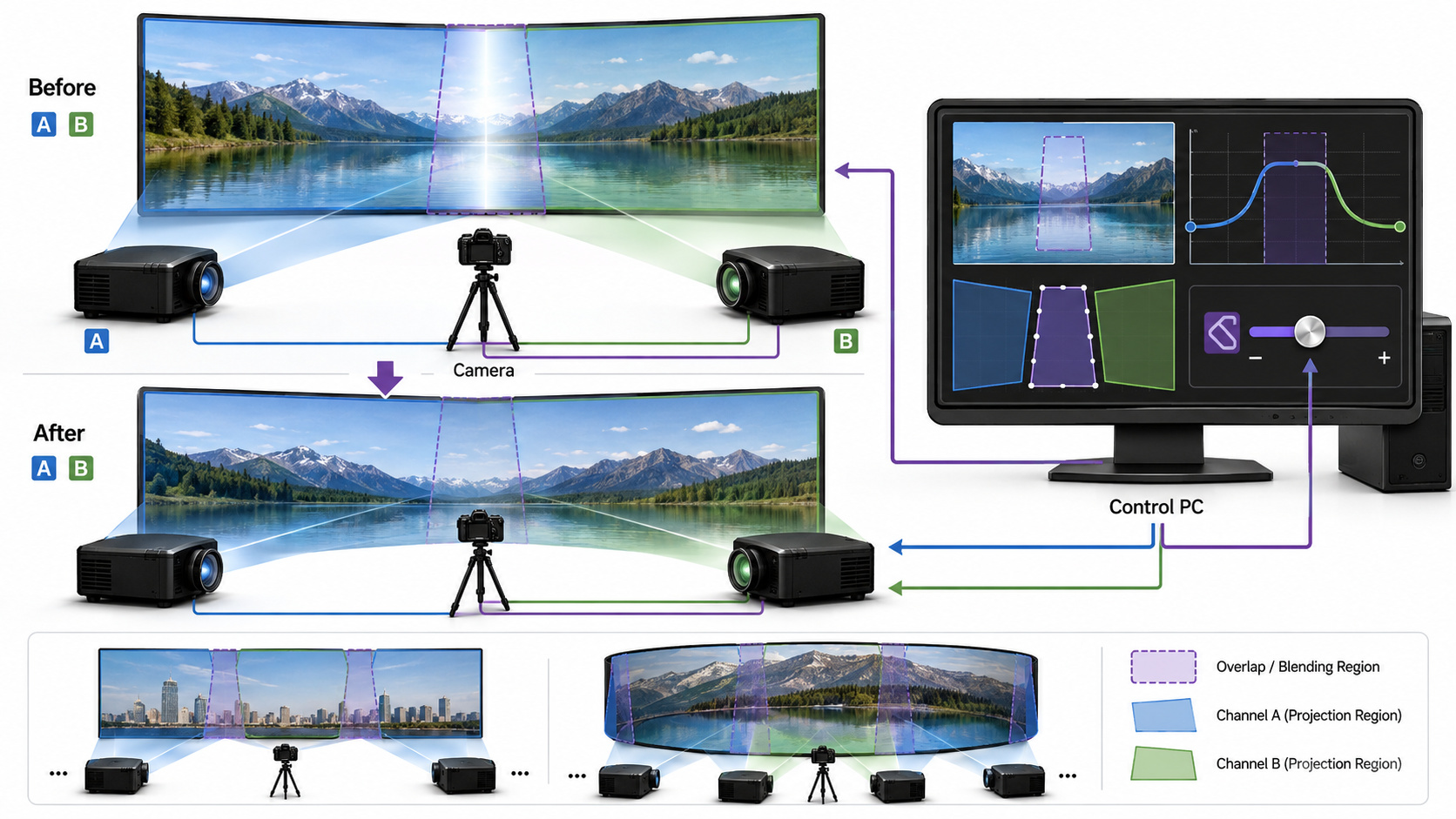
Adjacent projectors must overlap to form a continuous image, but their luminance contributions add together. A naive correction leaves a bright seam; excessive attenuation creates a dark stripe. This system uses measured image evidence and one meaningful control to make commissioning faster and more repeatable.
Define the overlap from the camera view, run a controlled correction and inspect the resulting spatial profile instead of repeatedly balancing several unrelated settings.
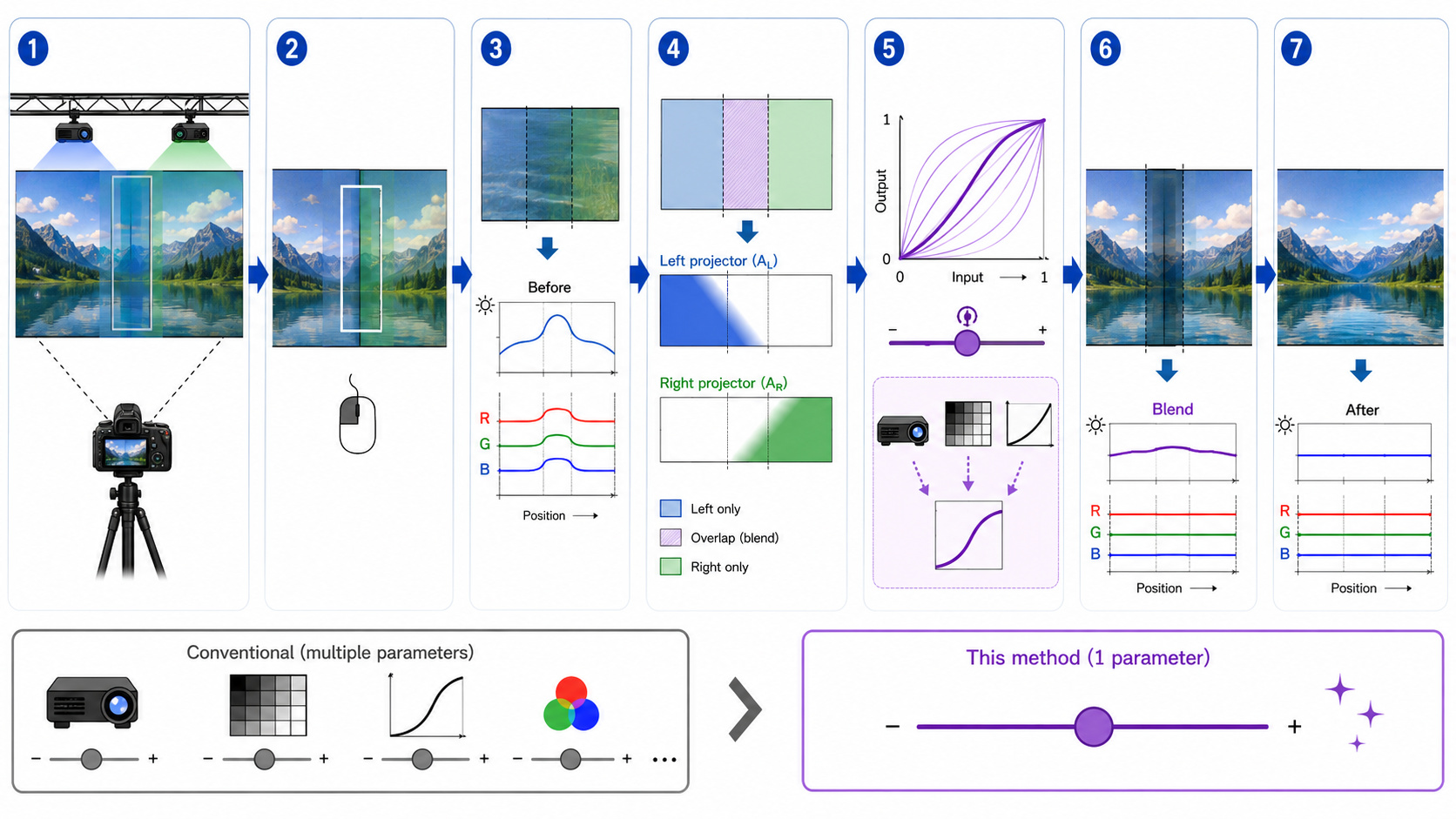
A unified parameter replaces a difficult combination of projector response, alpha and gamma controls while retaining predictable behaviour.
Alpha polygons distinguish normal and shared projection regions; normalized pixel luminance makes the overlap sum explicit and testable.
A still-video camera observes the target surface while an interactive rectangle establishes the overlap to be analyzed.
Separate left-only, right-only and shared regions, then assign normalized per-pixel luminance contributions across the seam.
Combine the projector luminance response, alpha transition and gamma correction into one function controlled by a single parameter.
Production acceptance should cover overlap localization, luminance flatness, RGB continuity, visible bright or dark bands, repeatability and consistency across every seam. Camera exposure and projector operating state should remain fixed or monitored so the correction reflects the display rather than acquisition drift.
Next step
Tell us what the process must decide reliably, and we will reply with the measurement we would make first.