
Inspect more of the screen in less time
Capture spatial defects, gradients and local loss of sharpness in one acquisition instead of manually moving a spot instrument across the display.
DISPLAY METROLOGY | CAMERA-BASED QUALITY ASSESSMENT
Product goal: turn a calibrated digital still camera into a fast, objective and repeatable display-quality instrument that captures every visible pixel in one exposure and connects the image to trusted quality metrics.
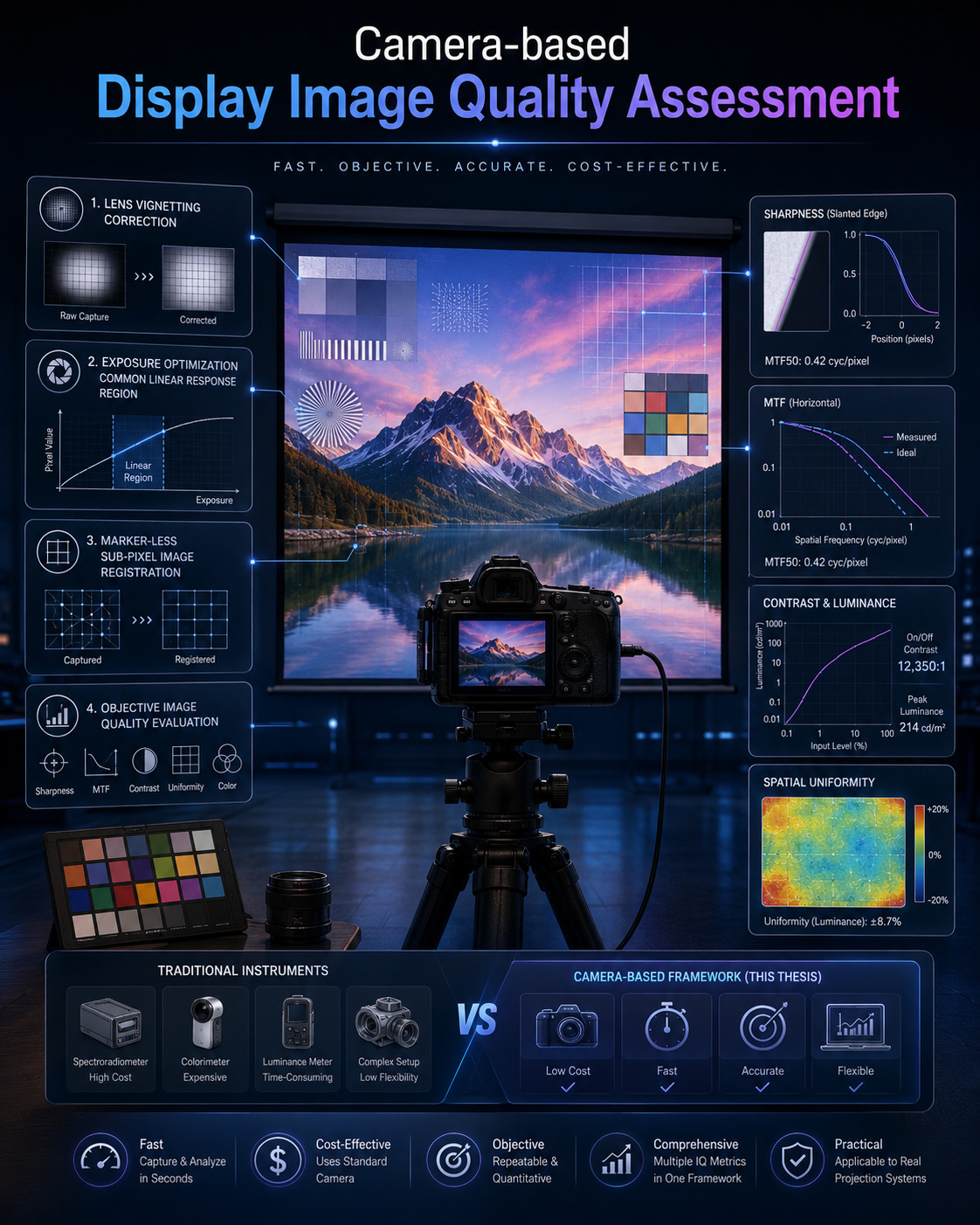
Colorimeters and spectroradiometers remain important reference instruments, but a camera can acquire the entire displayed image at once. With the right characterization and corrections, that speed becomes a practical route to automated production inspection, commissioning and comparative display evaluation.
Capture spatial defects, gradients and local loss of sharpness in one acquisition instead of manually moving a spot instrument across the display.
Reuse the same abstract workflow while adapting acquisition, corrections and metrics to a particular display technology and acceptance policy.
Camera response, saturation, vignetting, geometry, dust artifacts, registration and metric output remain explicit stages that can be tested independently.
Evaluate camera linearity and saturation, then optimize exposure and capture settings with reference to ISO, IEC and CIPA practices.
Compensate for lens vignetting, geometric distortion and dust shadowing before those effects can be mistaken for display defects.
A marker-less, view-independent method registers the photographed display with its original image so existing full-reference metrics can be used without modification.
The work produced an open-source software toolbox and eight research papers spanning camera characterization, color imaging, image processing, computer vision and subjective evaluation. A further method extended earlier subjective experiments through baseline adjustment, reducing the need to repeat a complete study when conditions changed.
Next step
Tell us what the process must decide reliably, and we will reply with the measurement we would make first.