
Recalibrate a projector in seconds
A short automatic pattern sequence produces the control-point evidence needed to rebuild the warp, reducing service time for large immersive displays.
PROJECTION GEOMETRY | DISCRETE OPTICAL SENSORS
Product goal: automatically recover the correspondence between projector pixels and physical screen control points, then warp the source image so curved and irregular projection surfaces display correctly aligned content.
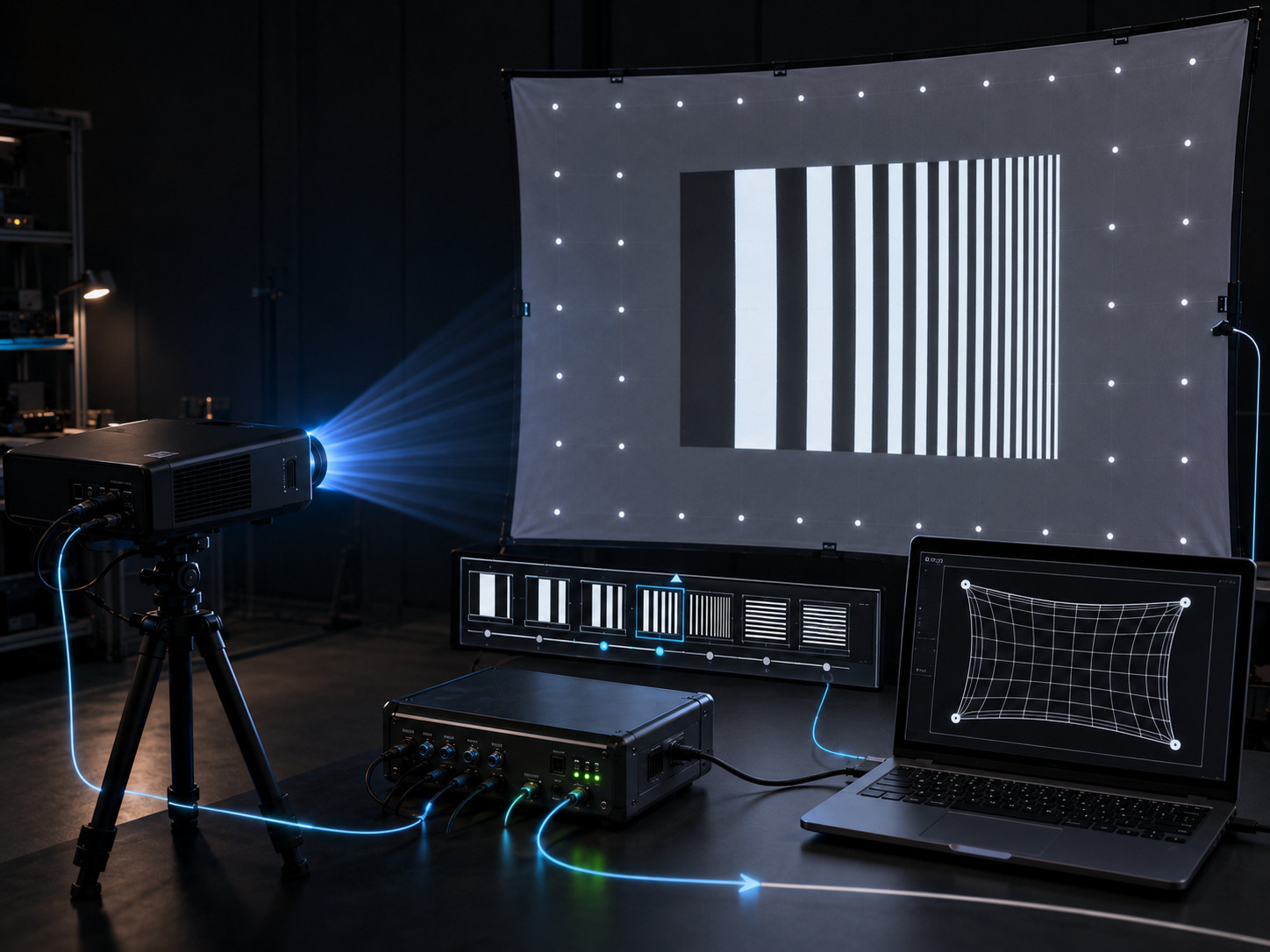
Curved displays distort projected content differently at every location. By placing inexpensive sensors at selected control points, the screen itself provides direct evidence of projector-to-surface correspondence—supporting rapid commissioning without a high-cost imaging instrument or lengthy visual alignment.
A short automatic pattern sequence produces the control-point evidence needed to rebuild the warp, reducing service time for large immersive displays.
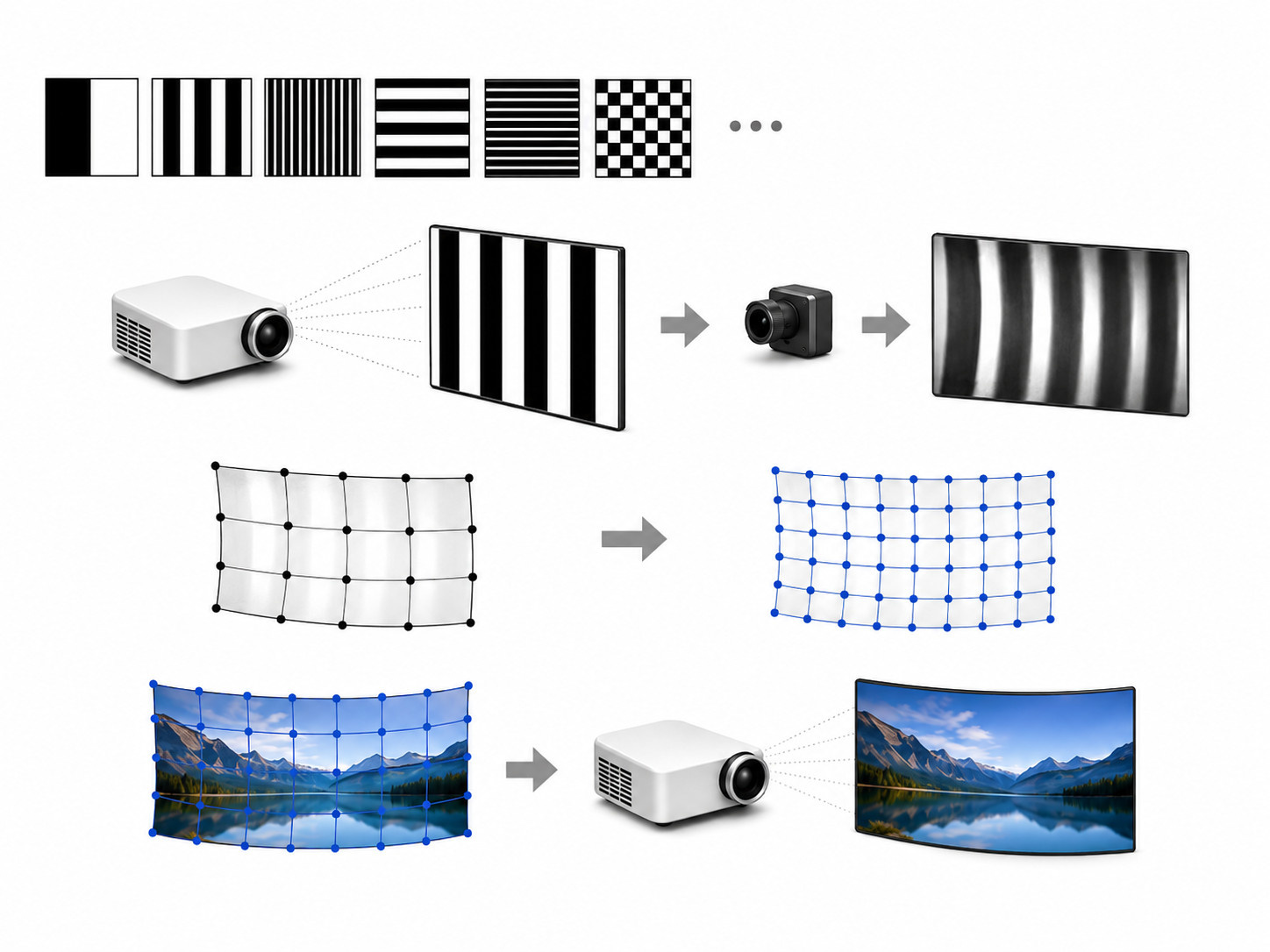
The correction is driven by measured control points rather than a hard-coded screen model, making the architecture applicable to planar, cylindrical, spherical and irregular surfaces.
Optical intensity is sampled, digitized and decoded into projector coordinates before a grid warp is generated, keeping every stage inspectable.
Off-the-shelf DLP projectors display a designed sequence that uniquely encodes locations across projector image space.
Selected optical sensors on the screen produce analog signals; a sampling-box prototype converts them into digital observations for the remote computer.
The pattern history observed by each sensor identifies its corresponding position in the projector coordinate system.
Production acceptance should test sensor repeatability, structured-pattern decoding, control-point coverage, warp continuity and independent geometric residuals on the screen. Missing or inconsistent sensor histories should be reported as invalid calibration evidence rather than silently interpolated into an apparently complete result.
Next step
Tell us what the process must decide reliably, and we will reply with the measurement we would make first.