
Apply one cleanliness standard
Support consistent screening across people, shifts and reusable-asset flows with visible review regions.
INDUSTRIAL QUALITY | CLEANLINESS AND DATA OPERATIONS
Product goal: compare local surface texture with clean references, produce an operational condition signal, and maintain curated front/back case sets for training and release verification.
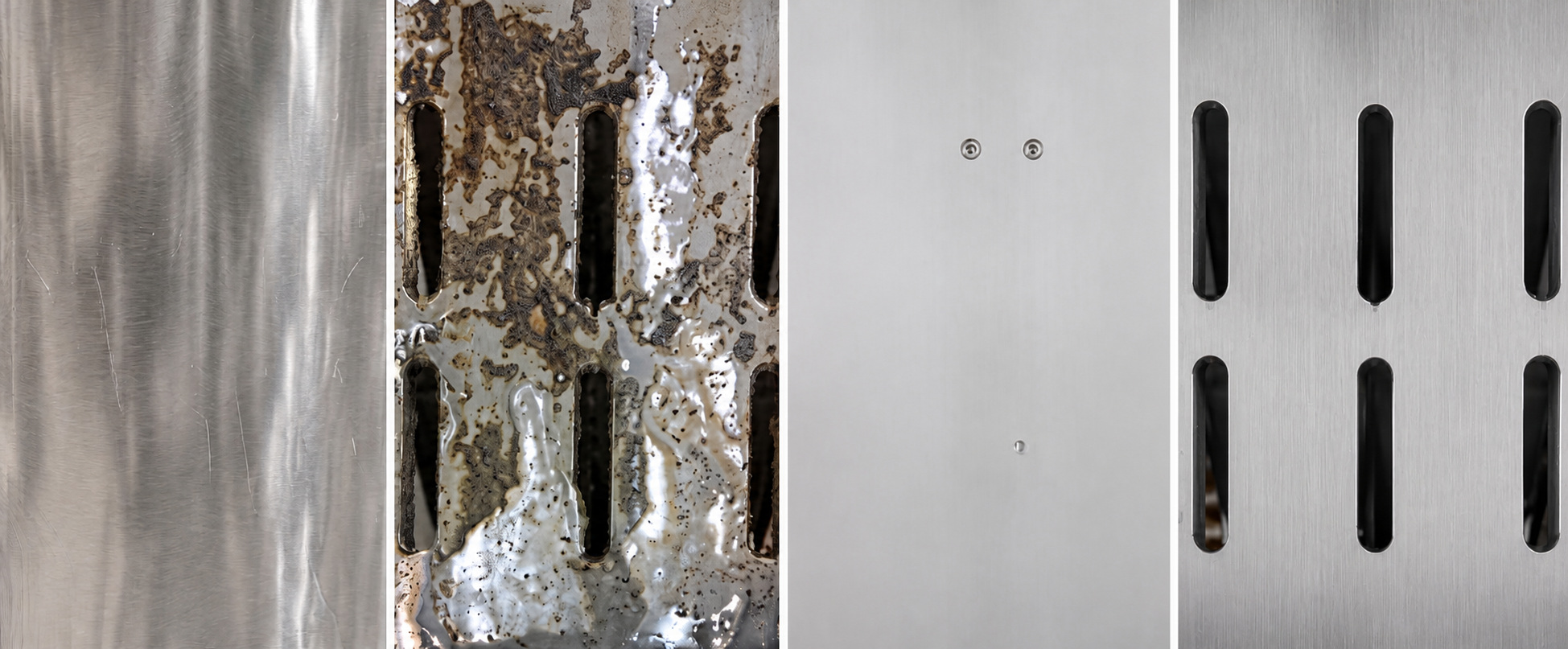
The model does not need to describe every possible stain semantically. It learns the distribution of clean reference texture, measures departure locally and uses curated condition cohorts to expose drift and failure modes over time.
Support consistent screening across people, shifts and reusable-asset flows with visible review regions.
Thresholds can reflect customer standards while local maps and stored cases explain the resulting decision.
Reference features, linear discriminant analysis, quadtree spatial subdivision and stable case identifiers create inspectable stages.
Standardize the relevant view, remove irrelevant context and divide it spatially so localized dirt remains visible.
Extract condition-sensitive features and use discriminant structure to estimate how each region differs from the accepted baseline.
Curated clean and inspection cases, separated by view and stable asset identifier, support regression checks after model or threshold changes.
The repository provides extensive organized imagery and a texture-analysis approach, but volume is not an accuracy claim. Validate against agreed operator labels across material wear, lighting, moisture and contamination types, while auditing duplication and split leakage in the case corpus.
Next step
Tell us what the process must decide reliably, and we will reply with the measurement we would make first.