
Increase tolerance to arrival variation
Allow handling cells to work from measured geometry while escalating pallets that cannot be localized safely.
3D PERCEPTION | MODEL-BASED REGISTRATION
Product goal: align an observed pallet point cloud with a known geometric model and publish the rigid position-and-orientation transform required by robot motion, inspection and asset-relative measurements.
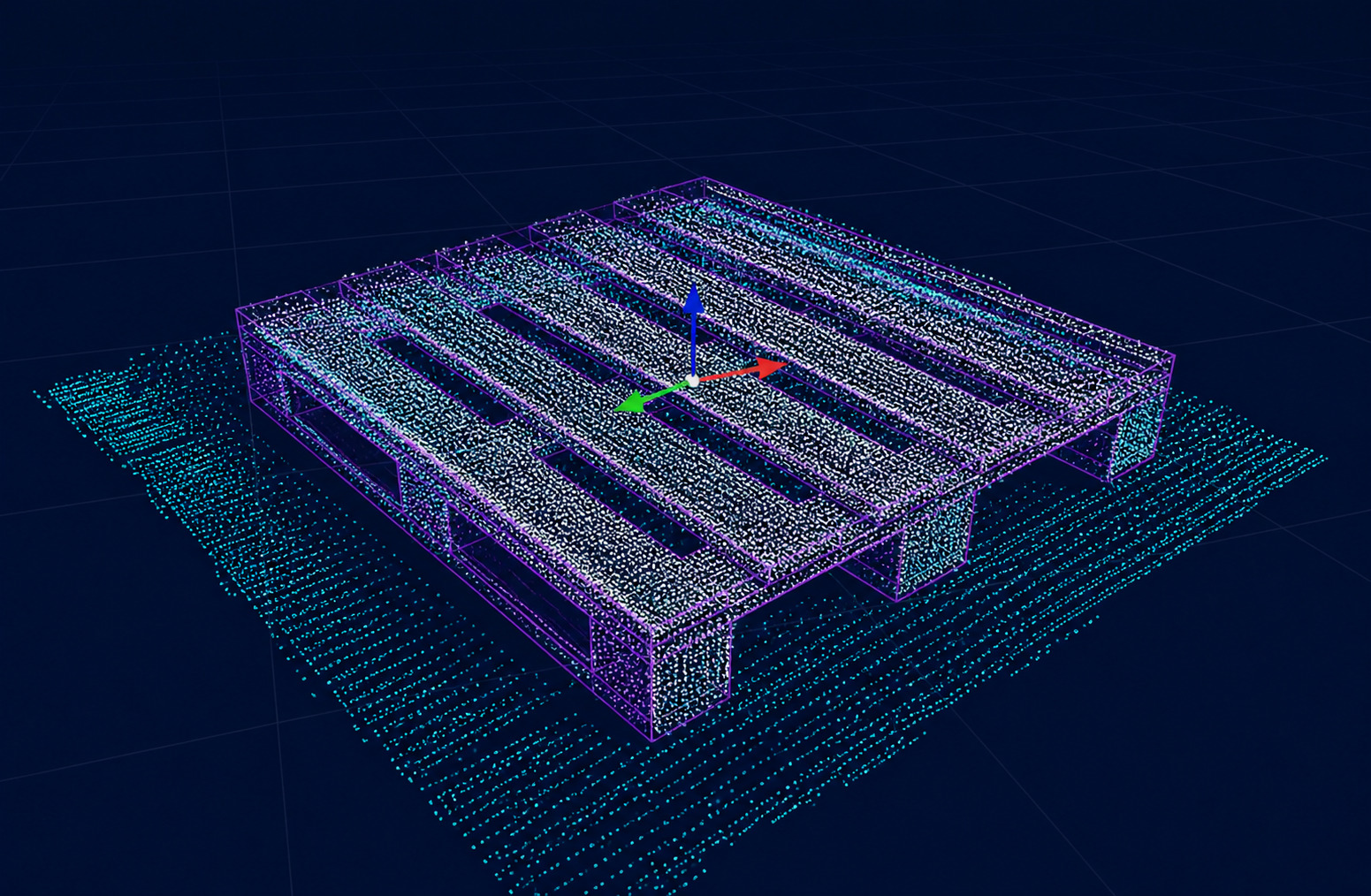
Warehouses cannot guarantee that every pallet arrives at an exact fixture pose. A reusable localization service absorbs normal placement variation, reduces hard-coded offsets and lets several downstream capabilities share one measured asset frame.
Allow handling cells to work from measured geometry while escalating pallets that cannot be localized safely.
Publish pose, fit quality and validity so inspection, picking and diagnostics consume the same result.
Center the observed cloud, transform candidate points and minimize nearest-neighbor disagreement against the pallet model.
Retain pallet-relevant points, reject obvious cell structure and remove gross translation before optimization.
A rigid transform is adjusted against a KD-tree nearest-neighbor objective; candidate initialization and geometry constrain convergence.
Fit residual, overlap, observability and transform bounds gate whether the frame is safe for downstream use.
The repository includes paired model and registration clouds plus several algorithm versions, but no universal deployment figure. Acceptance should cover partial views, pallet symmetry, clutter, missing points and starting-pose variation, then verify the downstream robot task.
Next step
Tell us what the process must decide reliably, and we will reply with the measurement we would make first.